



A Silhouette That Keeps Returning
There is a particular kind of jacket that announces itself before you even clock the details – the squared shoulders, the columns of round embossed buttons, the braided trim that borders on theatrical. The Napoleon jacket is back for fall 2026, and its arrival feels less like a trend and more like an inevitability. Military-influenced fashion has been circling the runways for a few seasons now, and the Napoleon silhouette is where that momentum has finally landed with full force.
It’s still summer, technically. But the evening air has that faint edge to it – the kind that makes you reach for something extra before stepping out. That transitional pull is exactly when a strong layering piece earns its place in a wardrobe, and few do it with more authority than a jacket that was designed, originally, to command a room.
Where the Jacket Comes From
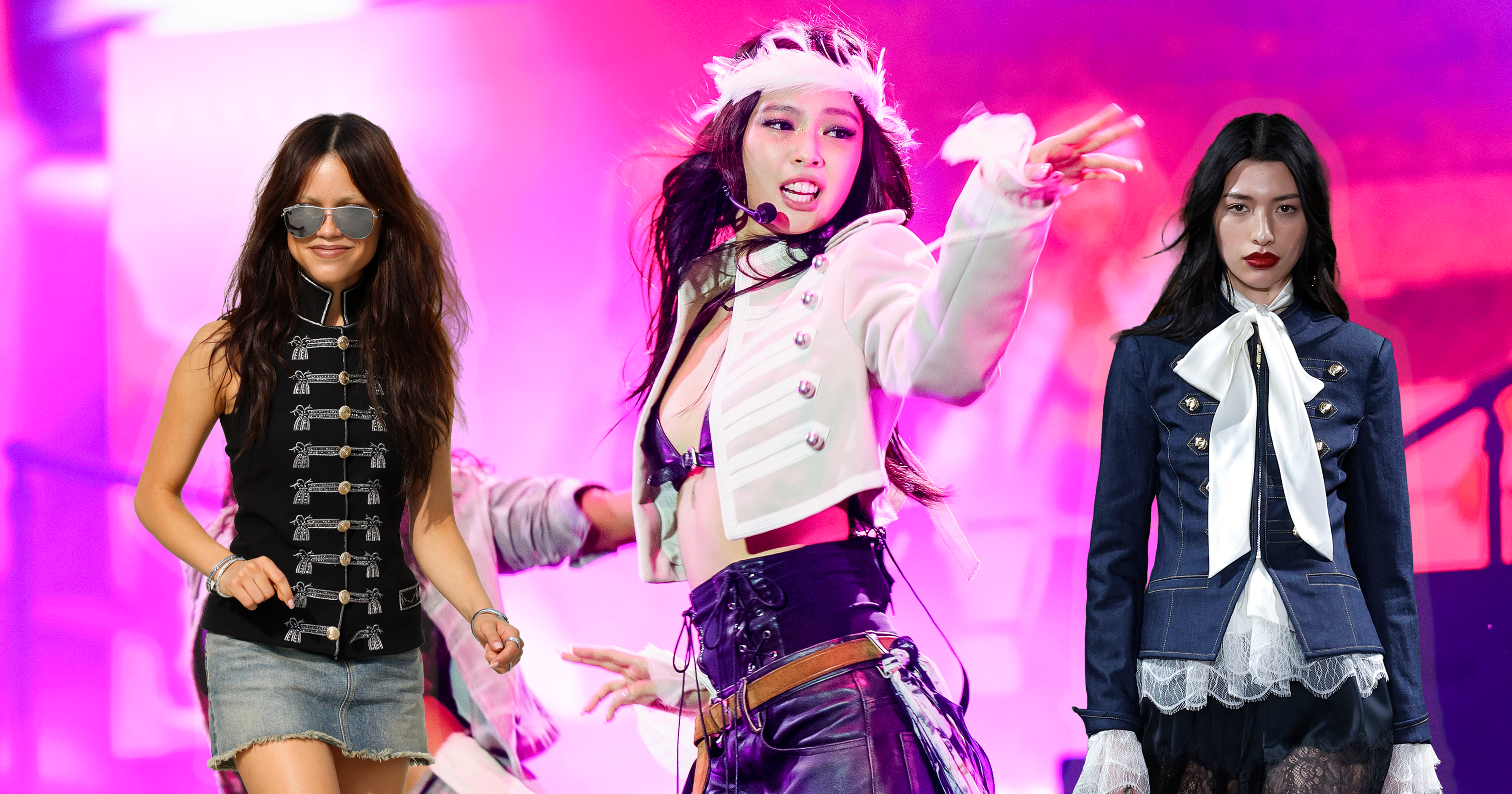
The jacket’s name is not incidental. It traces directly to 19th-century French military leader Napoleon Bonaparte, whose cropped uniform silhouette – structured, decorated, impossible to overlook – eventually crossed from battlefield to fashion house. Yves Saint Laurent was among the first to formally adopt it, incorporating the look into his collections in the late 1960s. That move set a template that the industry kept returning to.
By the 1990s, Jean Paul Gaultier and Thierry Mugler had each put their own interpretation on the silhouette, pushing it further into the territory of high fashion drama. It wasn’t only the runways driving the jacket’s cultural weight, though. Michael Jackson made the Napoleon jacket central to his stage aesthetic – not as costume, exactly, but as visual language. Kate Moss wore it with the kind of casual authority that made it look like something you’d already owned for years. Those two adoptions, from opposite ends of the cultural spectrum, did more to lock the jacket’s status into fashion history than any single collection could have.
Alexander McQueen and Ann Demeulemeester have been designing versions of the Napoleon jacket for decades, keeping the silhouette alive through seasons when other military references faded in and out. That sustained commitment from houses known for precision and intention says something about the jacket’s structural integrity as a design object – it is not easily exhausted.
Why Military Fashion Returns When It Does
Fashion psychologist Shakaila Forbes-Bell has noted that a surge in military-influenced clothing is always a sign of the times. The instinct to dress in structured, armor-like clothing tends to surface during periods of collective uncertainty – the silhouette becomes a way of projecting control and authority when the broader environment feels unstable. That reading makes the Napoleon jacket’s current moment feel less arbitrary.
What’s notable about this particular cycle is the breadth of brands involved. It’s not just the heritage houses that have designed Napoleon jackets for years – the last few seasons have seen a spread of labels, large and small, all drawing from the same military uniform reference. When a trend moves that far down the market simultaneously, it typically means the visual shorthand has already been processed by enough people to feel immediately recognizable without needing to be explained.
How to Actually Wear It Now
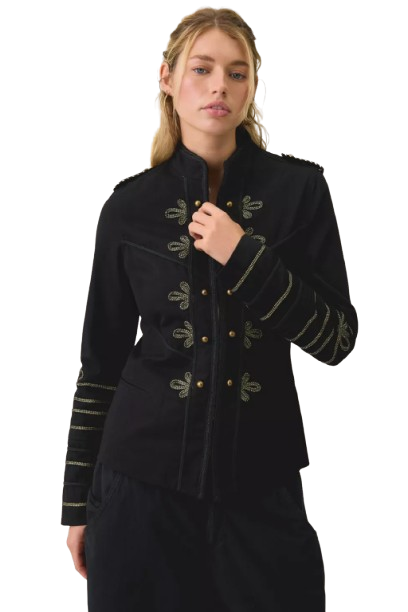
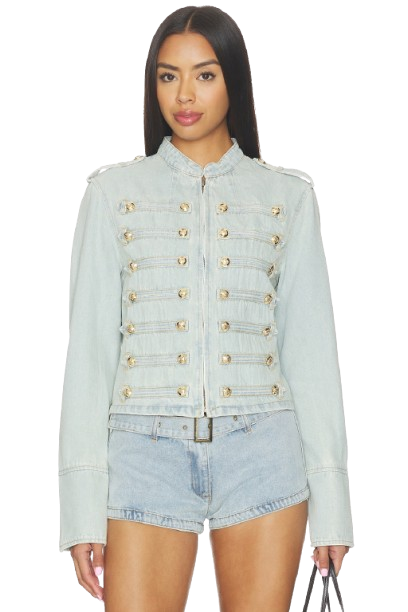
The contemporary Napoleon jacket is defined by a few recurring elements: a strongly defined shoulder, color combinations built around navy, gold, white, and red, and round embossed buttons – whether functional or purely decorative. Those details are consistent enough across brands that the jacket reads as a unified trend rather than a loose category, which makes styling it relatively direct.
Pairing it with a simple denim and plain tee base is the fastest route to making it work without overthinking. The jacket handles the statement; the rest of the outfit doesn’t need to compete. That dynamic – something easy underneath, something considered on top – is where the Napoleon jacket genuinely earns its reputation as a layering piece rather than a costume. It absorbs a plain outfit and lifts it without demanding that everything else change. Check out how flared jeans are pairing with ballet heels this fall for another bottom-heavy silhouette that balances well against a structured top.
Color choice matters more with this jacket than with most. The classic navy and gold combination reads formal, almost ceremonial – closer to the original military reference. Red and white versions pull away from that and land somewhere more contemporary and aggressive. If the goal is to wear it in daytime contexts without it reading as costume, the muted or tonal versions of the silhouette – where the buttons and shoulders do the structural work without the full regimental color palette – tend to carry more flexibility.
The cropped cut, which is one of the jacket’s defining features, creates a natural visual break that works well over high-waisted trousers or straight-leg denim. The proportions aren’t accidental – the original uniform silhouette was designed to emphasize the torso and create an upright, elongated line, and that geometry translates directly into how the modern versions sit on the body. A longer hem undermines the effect. The jacket is supposed to end where it ends.
The question the current cycle raises is whether the Napoleon jacket will follow its historical pattern – absorbed into the mainstream, then gradually softened into something less precise – or whether the concentration of designers working with it simultaneously means this version has enough structural momentum to stay sharp. The last time this many labels converged on a single military silhouette at once, it was the early 2000s peacoat wave, and that particular jacket never fully left.