




A Childhood Gap, Finally Filled
For a certain generation of kids raised on ’90s movies, summer camp looked like freedom in its purest form. The Parent Trap and It Takes Two made cabin wars, shaving-cream ambushes, and marshmallow-toasting look like the defining experiences of girlhood – the kind that produced lifelong friendships forged in two stolen weeks away from parents. Writer Raquel Reichard watched all of it from the living room sofa, her Puerto Rican mother laughing beside her, and still couldn’t get a yes when she asked to go.
The answer was always the same: “No, hay hombres.” Men she didn’t know. Men far enough away that her mother couldn’t intervene. The same reasoning that kept Reichard from sleepovers at friends’ houses applied doubly to a week in the woods with strangers. So she watched the movies, filed the longing somewhere quiet, and grew up. Then, in July, she stopped waiting and signed herself up.
Why the No Made Sense – and Why It Still Stung
Reichard is clear that she doesn’t blame her mother. A 2025 study published in the peer-reviewed journal Trauma, Violence, & Abuse found that 3.7% of surveyed adults report experiencing child sexual abuse within youth service organizations – a category that includes summer camps, sports clubs, and religious organizations. That number, paired with the headlines that surface regularly about institutional failures in exactly those settings, makes a cautious Puerto Rican mother’s instinct look less like overprotection and more like pattern recognition.
Still, understanding a decision intellectually doesn’t always dissolve the feeling underneath it. The inner child that wanted tug-of-war and whispered cabin conversations didn’t disappear when Reichard learned to contextualize her mother’s reasoning. She just got older, accumulated her own autonomy, and eventually realized nothing was stopping her from making the choice herself.
That realization is more common than it might seem. Adult camps have expanded quietly over the past decade, built on the premise that the camp experience – structured play, communal eating, being outside without an agenda – isn’t inherently a children’s privilege. For adults who missed it, whether because of cost, cultural caution, geography, or circumstance, the appeal isn’t nostalgia so much as access to something that was simply never available the first time around.

Camp Elevate, Sponsored Carefree-ness Included
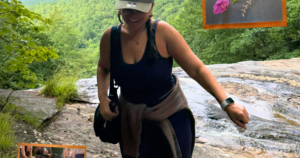
Reichard’s camp experience was Camp Elevate, a program curated by Chase and Marriott Bonvoy to showcase the benefits of the Marriott Bonvoy Boundless Credit Card. The camp was held at Trailborn, and the experience was designed for adults – meaning it carried the structure and activities associated with traditional summer camps while operating in a setting that didn’t require anyone to share a bunk with someone they’d just met on a Tuesday.
The corporate backing matters as context, not as a critique. Branded experiences now occupy a real and expanding space in the adult leisure market – companies attaching their products to aspirational activities that consumers actually want to do. The difference here is that the underlying activity, going to camp as a grown adult, carries genuine emotional weight for a subset of people who didn’t get to do it as children. The credit card is incidental. The week in the woods is the actual point.
What Gets Recovered, and What Doesn’t
There’s something specific about the camp experience that resists being replicated in other settings. It isn’t just being outdoors – people hike, camp, and rent cabins all the time without touching what camp culture actually offers. It’s the combination of enforced togetherness, low-stakes group activities, and the temporary suspension of adult responsibility that makes it feel different. Friendships that form at camp, even adult camps, tend to accelerate because the environment removes most of the usual friction of getting to know someone.
Reichard framed her attendance as a gift to what she called “Baby Quels” – the younger version of herself who filed that longing away and waited. That framing is interesting because it locates the value of the trip not in the activities themselves but in the act of going back for something that was missed. It’s less about the marshmallows and more about closure that doesn’t require anyone else to apologize.
What’s harder to recover is the specific texture of being a kid at camp – the way two weeks can feel like a full season, the ease of making friends when you’re eight and have no complicated history yet, the sense that the woods are infinite. Adult camp approximates those things but can’t fully restore them. The people who attend know this. They go anyway, because the approximation is closer than anything else available.
Reichard’s mother still lives somewhere in that original calculation – the one that kept her daughter home every summer, trading camp for the sofa, The Parent Trap for the real thing. Whether a branded adult camp weekend in July actually closes that gap, or just gives it a different shape, is a question Reichard herself probably hasn’t finished answering.