




Fútbol Has Always Been Personal
The 2026 FIFA World Cup does not belong equally to everyone. Latin America has a specific, documented claim on this tournament – one that stretches back to Uruguay winning the inaugural championship in 1930, runs through Brazil’s record five titles, and ends, most recently, with Argentina lifting the trophy in 2022. No other region has that kind of résumé, and the culture around the sport reflects it.
This time around, the stakes feel even more charged. Colombia’s Shakira – already synonymous with the World Cup through anthems like “Waka Waka” – is headlining the tournament’s first-ever halftime show at the 2026 World Cup Final. Watch parties, flag gear, and heated refereeing debates are already being planned across Latin America and throughout the diaspora. The question of what to wear to all of it has some genuinely good answers, especially if you’d rather put money behind brands that grew out of the same communities doing the most celebrating.
The Brands Building Their Own Kits
Miami-based Voight is a Latina-owned label covering lingerie, swimwear, apparel, and accessories – and its Latina League collection is exactly what it sounds like: country-rep beachwear with actual design ambition. The standout is the Brasil V-kini Set in yellow, which works as a beach day piece and, paired with shorts, holds up at an indoor watch party without reading like a costume. It’s a practical distinction. Most team merchandise forces you to choose between athletic gear and something actually wearable in daily life. The Latina League set sidesteps that problem.
Carolina K, another Latina-owned brand, went in a different direction with its La Diez Open Stitch Argentine Polo. It’s a limited-edition v-neck jersey that includes a hand-embroidered Sol de Mayo – the sun symbol centered on the Argentine flag. That kind of detail is not an afterthought. Hand embroidery on a jersey signals that someone treated this as a garment worth finishing properly, not a licensing opportunity.
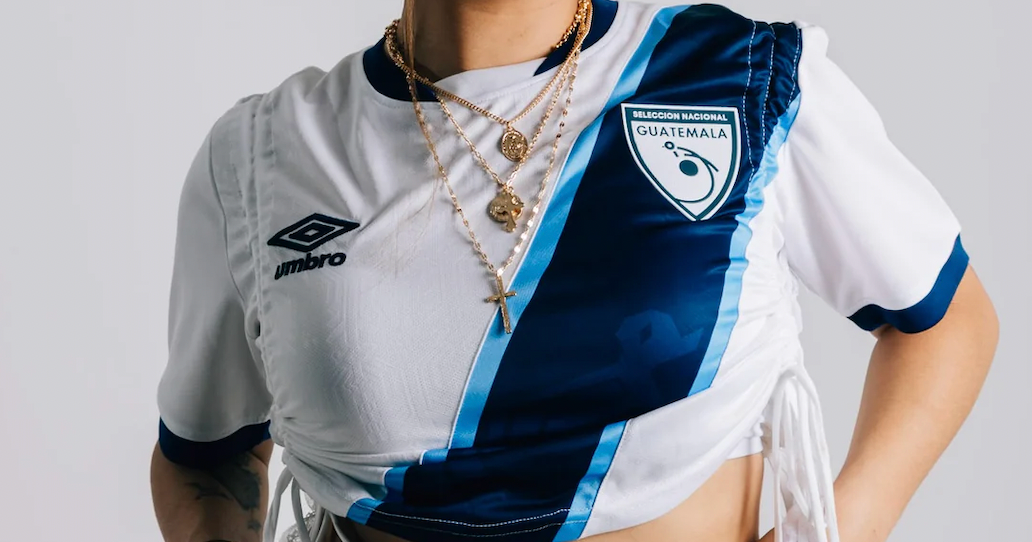
Then there’s Retro Fitted LA, which has built its identity around upcycling vintage jerseys rather than producing new ones. Their reworked Guatemala jersey draws from existing material – reshaped, reconstructed, given a second context. For people who care about where clothing ends up, or who want something that doesn’t exist in a warehouse somewhere, that approach means something. It also means the piece is, by definition, one of a kind.

Why Sourcing Matters During Events Like This
Major sporting events flood the market with officially licensed merchandise, most of it produced quickly and at scale, none of it connected to the communities most invested in the outcome. The economics are straightforward: FIFA and its partners capture the commercial moment; the fan base generates the demand; the money rarely circulates back. Shopping from Latine-owned brands during the World Cup cycle is a small structural correction to that pattern.
It’s also, practically speaking, how you end up with better things. Voight’s swimwear, Carolina K’s embroidered polo, and Retro Fitted LA’s upcycled jerseys are all products that required decisions – about materials, construction, cultural specificity – that mass licensing agreements don’t accommodate. The World Cup runs for weeks. The gear you buy for it doesn’t have to disappear from your wardrobe the day the final whistle blows.
What to Actually Buy and Why
If you’re attending outdoor watch parties or heading somewhere warm during the tournament, Voight’s Brasil V-kini Set is the most versatile entry point. Yellow reads as intentional rather than generic, and the two-piece construction means it adapts. It’s available directly through Voight’s site, which is worth knowing because the Latina League collection runs limited quantities.
Carolina K’s La Diez Argentine Polo is the pick for anyone who wants to represent Argentina without wearing a replica jersey from a sporting goods chain. The limited-edition status is real – hand-embroidered pieces don’t get restocked the same way. If Argentina makes a deep run in the tournament, which given their 2022 title defense position is entirely plausible, demand for anything Argentina-adjacent is going to spike. The window to get this one is now.
Retro Fitted LA’s Guatemala jersey occupies a different space entirely. Guatemala is not among the tournament’s traditional powerhouses, but the diaspora is large, the pride runs deep, and upcycled jerseys carry a history that new production can’t manufacture. Retro Fitted LA has built a following specifically by understanding that vintage rework is not nostalgia – it’s a different relationship with the object itself.
All three brands are independently owned and selling direct. None of this requires navigating a major retailer or a FIFA licensing portal. The practical path and the more considered one happen to be the same path, which is not always how these things work out.
Shakira performs the halftime show. Argentina defends its title. Brazil chases a sixth. And someone, somewhere, is already arguing about whether Uruguay’s 1930 win counts as the true origin of Latin American football dominance. The gear you show up in might be the least contested thing about the next several months.