





Christopher Nolan’s adaptation of The Odyssey arrives with Matt Damon as Odysseus, a runtime approaching three hours, and a surprisingly quiet confidence – shot entirely in IMAX 70mm, it pulls one of the oldest stories in Western literature into something that feels genuinely unsettled and alive.
A Puzzle Built From Memory and Myth
Nolan is not known for restraint, which makes its presence here so disorienting. He doesn’t take the kind of creative liberties that audiences familiar with Oppenheimer or Interstellar might anticipate. Homer’s characters remain intact. The gods are still gods. The monsters still kill. What Nolan adds is his signature fracturing of time – flashbacks deployed not for mystery’s sake but as a structural argument about how memory shapes identity and keeps a person tethered to, or trapped by, who they once were.
The result is a film that functions less like a linear epic and more like a puzzle assembled in real time. Scenes don’t always land where you expect them. Odysseus’s journey home from the Trojan War comes to you in pieces, and the disorientation is intentional – the audience is meant to inhabit his psyche, not just observe it. Damon carries that weight without leaning into heroic posturing, which is exactly the right call for a character whose defining trait is endurance rather than glory.
The Bronze Age setting is rendered with the full scale IMAX 70mm allows, but the film never becomes a spectacle of production design for its own sake. The world feels ancient without being remote. That grounding is what allows the mythology to land as something more than decoration – Zeus’ Law, the governing social contract of this world, functions as the story’s moral skeleton.
Zeus’ Law demands that citizens welcome beggars and kings at the same table, that soldiers fight with honesty and integrity, and that every person – regardless of class – be treated with dignity. Violating that contract doesn’t just invite social censure. It invites divine punishment. The law is absolute, and the film takes it seriously. It’s not presented as quaint ancient politics. It’s the load-bearing wall of the entire story.
Why the Women Are the Actual Story
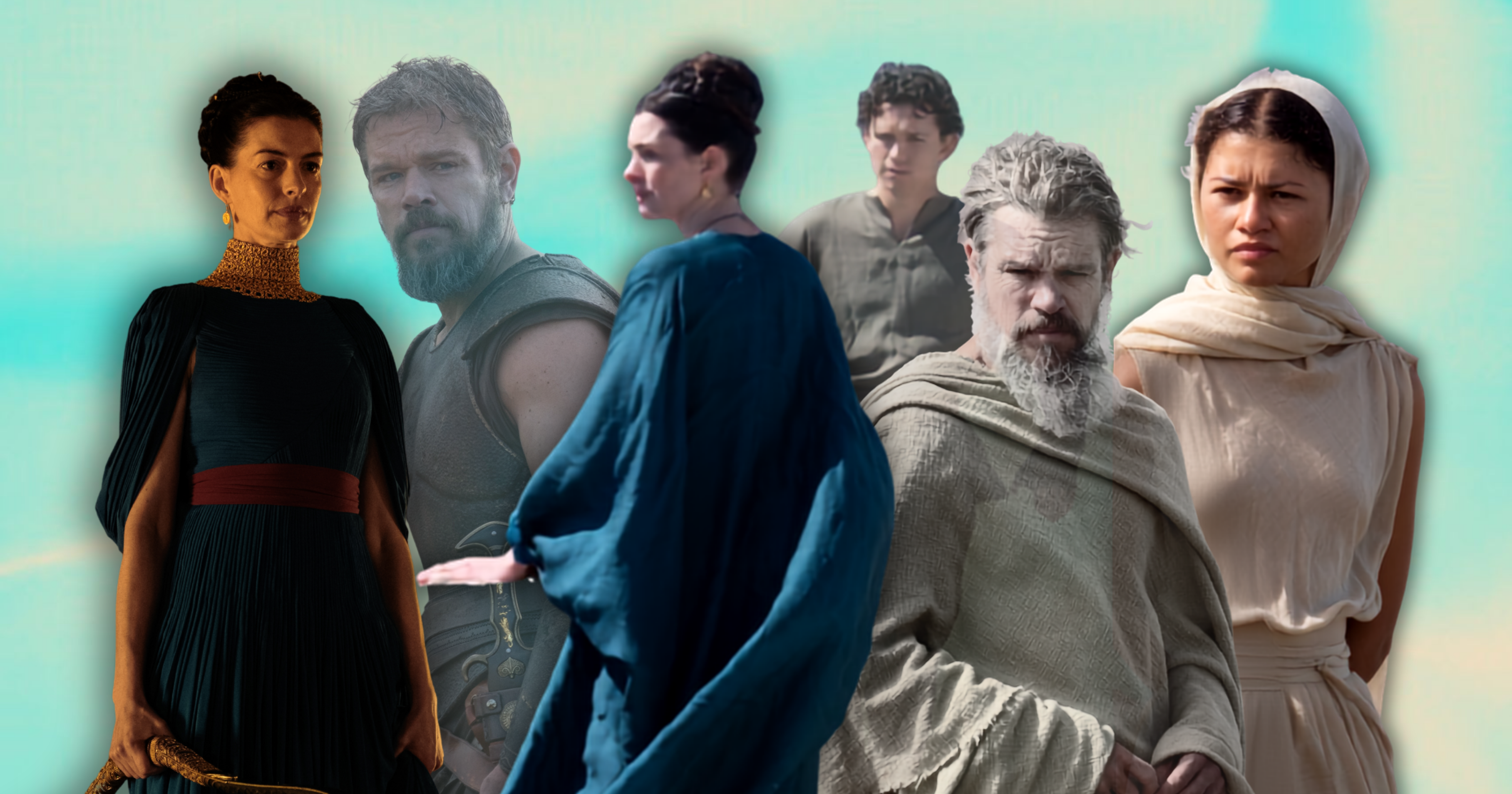
For all its battles and sea monsters, what holds The Odyssey together emotionally is its women. Nolan leans into this rather than papering over it. The female characters are not softened love interests or waiting wives reduced to weeping – they move the plot, make decisions with real consequence, and provide the moral scaffolding Odysseus needs to find his way back to something resembling himself. In a story whose surface themes are overwhelmingly masculine – war, glory, homecoming, the restoration of male authority – the women are where the actual reckoning happens.
This is not the Odyssey you parsed in AP Literature. That version often centered the men and treated the women as static endpoints: Penelope weaving and unweaving her shroud, Circe as a dangerous detour, Athena as a convenient plot device. Nolan’s film redistributes the weight. The gods and the women function almost as a single force here, both operating outside the rigid hierarchy of war and both more interested in restoration than victory.

Penelope’s position in the story has always been a study in strategic patience – she holds Ithaca together while suitors eat through the household and Odysseus fails to return. But patience in this adaptation reads less like passivity and more like its own form of endurance. She is managing a collapsing social order from inside her own home, which is its own kind of war. The film gives that situation the weight it deserves rather than treating it as backstory.
The gods occupy a similar space. They’re not spectators offering occasional thunderbolts. They have stakes. Athena’s investment in Odysseus is personal and complicated; Poseidon’s obstruction is a grudge with real theological dimensions. What makes the divine interference feel meaningful rather than arbitrary is that the gods, like the women, are responding to violations of Zeus’ Law – to the collapse of the social contract that was supposed to hold the world in order. Everyone who breaks that law pays for it. Everyone who upholds it, barely survives.
That collapse – greed at the top, the powerful consuming more than their share, the rules that were supposed to protect the vulnerable being discarded by those with nothing to lose from discarding them – is where the film finds its contemporary friction. Ithaca’s rot comes from within, from men who took advantage of an absence and called it opportunity. The women watched it happen and found ways to survive it. That dynamic doesn’t require any updated dialogue or modern costuming to read as current. Homer already wrote it.
What the IMAX Format Actually Does to This Story
Shooting in IMAX 70mm is a choice with real narrative implications, not just a prestige flex. The format fills peripheral vision, which changes how mythological scale registers physically. A sea monster doesn’t need to be explained when it takes up the entire field of sight. Odysseus’s isolation on open water lands differently when the water has no visible edge. Nolan has used the format before, most extensively in Oppenheimer, but the material here benefits from it in a different way – myth lives in scale, and this format gives the film room to honor that without CGI excess.

Nearly three hours is a commitment, and the film earns some of that runtime more than others. The puzzle structure means certain sequences carry more emotional weight on second viewing than they do in the moment – which is either a feature or a problem depending on how much patience you bring into the theater. What doesn’t drag is anything involving the women and gods steering Odysseus toward the person he was before the war stripped him down. The idea of women quietly absorbing the cost of men’s choices – and deciding how much longer they’re willing to – runs through very different kinds of stories right now, and it lands here too. The film ends not with triumph but with arrival, and the difference between those two things is everything Odysseus lost on the way home.