




An Unexpected Arrival
Animated films have spent the better part of a decade training audiences to expect either franchise-driven sequels or awards-bait tearjerkers with diminishing returns. Forgotten Island arrives without that baggage – a movie rooted in Filipino folklore, voiced by an ensemble that actually reflects the culture it depicts, and built around a premise that somehow manages to be funny, emotionally devastating, and visually distinctive all at once.
The story follows best friends Jo, voiced by H.E.R., and Raissa, voiced by Liza Soberano, who wake up with no memory of the previous night and find themselves stranded in Nakali, a mysterious world drawn from Filipino mythology. They navigate monsters, creatures, and animals across this unfamiliar terrain – but the real threat isn’t the world around them. If they don’t find a way home, they risk losing the one memory that defines them: each other. It’s a structure that borrows emotional logic from films like Eternal Sunshine of the Spotless Mind and the disorienting comedy of The Hangover, filtered through a cultural lens that Hollywood animation has rarely attempted with this level of sincerity.
What the Animation Actually Does
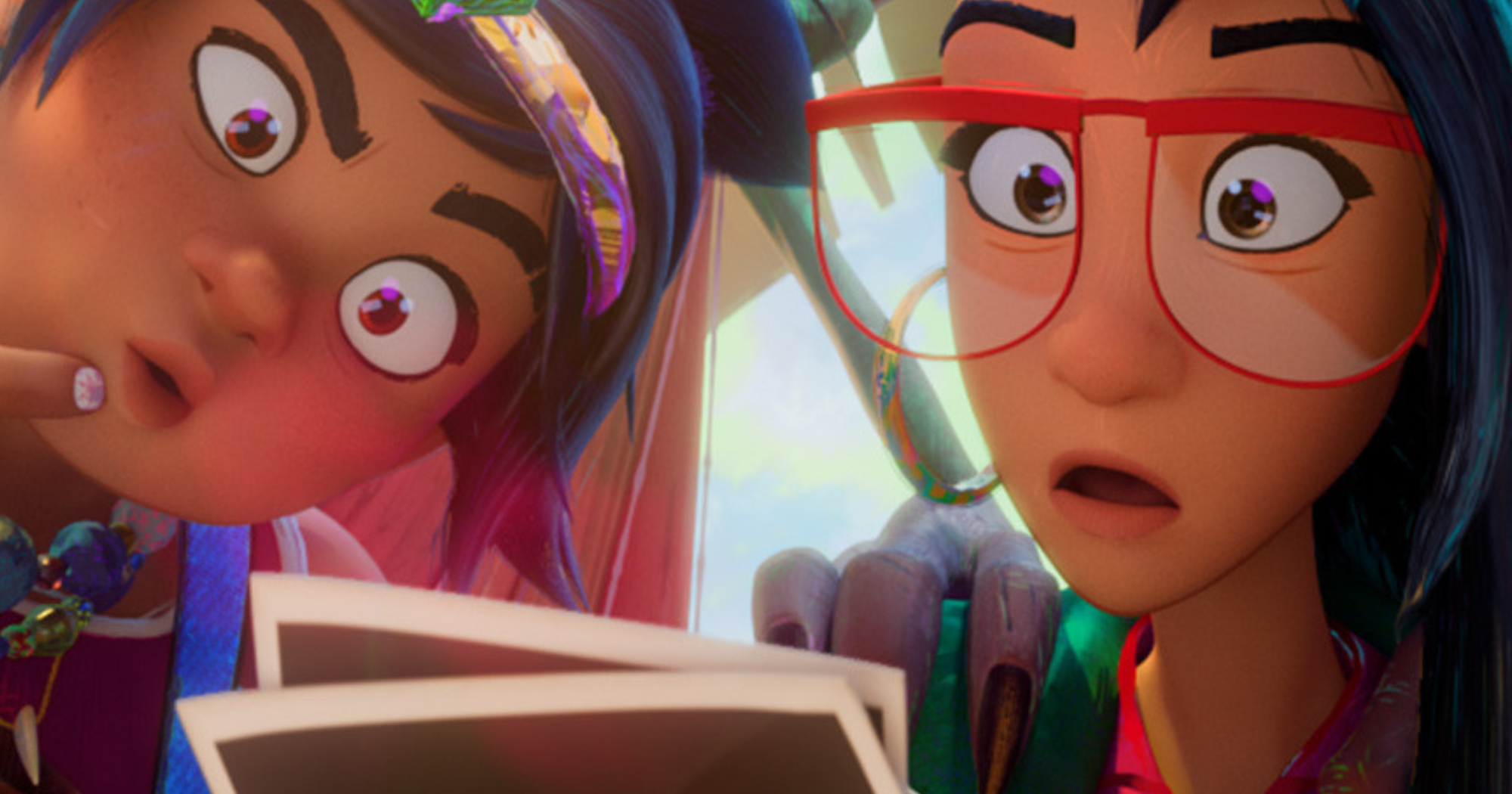
The first thing that registers when watching Forgotten Island is the visual approach. The animation style draws immediate comparisons to Spider-Man: Into the Spider-Verse – not as a knock-off, but in the sense that it carries that same awareness that animation doesn’t have to look like everything else. It has texture and intention.
That visual choice carries political weight, even if unintentionally. For years, Southeast Asia has been rendered in Hollywood productions through a yellow color grade – a filter that has come to visually code these regions as impoverished, unstable, or otherwise lesser. It’s a subtle but persistent form of visual racism that has gone largely unchallenged in mainstream cinema. Forgotten Island rejects it entirely. The Philippines in this film is rendered in full, saturated color – vibrant greens, deep blues, the kind of palette that treats the setting as something worth celebrating rather than pitying. For Filipino audiences and diaspora viewers, that choice alone carries significant emotional weight.
The cast assembled around that visual identity is equally deliberate. Alongside H.E.R. and Liza Soberano – who has been building toward a Hollywood presence after years of prominence in the Philippines – the film features Lea Salonga, Dolly de Leon, and Manny Jacinto. These aren’t token inclusions. They are performers with genuine cultural ties to the material, and their presence gives the film a credibility that casting decisions in so many “diverse” animated projects have failed to achieve.
Soberano’s involvement, in particular, has been years in the making. She has been navigating the path from Filipino stardom to international recognition for some time, and Forgotten Island feels like a genuine arrival moment rather than a stepping stone. Pairing her with H.E.R. – a Grammy-winning artist making her animated voice acting debut – creates a central friendship that has real energy, the kind that makes the film’s emotional stakes feel earned rather than manufactured.
The Friendship at the Center
What the film understands – and what so many animated features fumble – is that the friendship between Jo and Raissa has to be worth saving for the audience to care whether it survives. The entire premise depends on it.
The memory-loss structure gives the film a strange, melancholy undertone that sits beneath all the creature encounters and comedic moments. Jo and Raissa aren’t just trying to find their way home; they’re racing to reconstruct who they are to each other before that knowledge disappears entirely. It’s a surprisingly mature emotional throughline for a family film, and it lands hard in the final act – the kind of ending that brings people to tears not because it’s manipulative, but because it has done the work of making you care over the preceding 90-plus minutes.
Where It Sits in the Landscape
Pixar, once the gold standard for animated storytelling – the studio behind a run of films where virtually every release felt like an event – has been in a more uncertain period. The consistency that defined its peak years has faded, and audiences have noticed. Forgotten Island doesn’t come from Pixar, and that might actually be the point. It arrives at a moment when the door is genuinely open for a different kind of animated film to connect.
Whether it becomes the breakout hit that its early reception suggests is still an open question. The combination of Filipino cultural specificity and broadly accessible emotional storytelling is either going to expand what general audiences expect from animation, or it will be celebrated in a narrower lane and forgotten in a year. The film clearly has believers – writers Bernice Corral and Rachel Choy, who saw the film ahead of release, described it as something genuinely memorable, with Corral citing her long investment in Soberano’s career as context for why the film felt like a milestone rather than just a release.
The cultural significance of seeing the Philippines rendered without condescension, without the visual shorthand that has flattened Southeast Asian settings for decades, and with a cast that has actual roots in the culture – that isn’t a small thing. It’s the kind of detail that viewers who have spent years watching their countries misrepresented on screen notice immediately and carry with them long after the credits roll.
Manny Jacinto is in this film. Lea Salonga is in this film. Dolly de Leon – who broke internationally with Triangle of Sadness – is in this film. That alone is worth sitting with.