




The Invisible Language of Fragrance
When I came out as trans in 2017, I spent a lot of time thinking about Shakespeare. Specifically the line from Romeo and Juliet – “What’s in a name? That which we call a rose by any other name would smell as sweet” – because choosing my name felt like the most visible, most loaded act of becoming myself. My name was external confirmation. It was other people saying, yes, this is who you are, and meaning it. That mattered enormously.
What I didn’t clock at the time was the other half of that quote. The smell. Fragrance is woven so tightly into how we present ourselves to the world that its absence from conversations about identity feels almost willful. For trans women especially, scent carries weight that goes far beyond preference – it becomes part of a daily negotiation between safety, expression, and the quiet, persistent act of being.
Before the Label, the Loophole
Before I came out, I bought fragrances that sat as far toward the center of the gender spectrum as possible. Not because I loved androgynous scents in principle, but because they gave me cover. A gender-neutral fragrance let me stay close to femininity without anyone asking questions. It was a workaround – small, private, and entirely mine. The bottle on the shelf said nothing. The scent on my skin said everything I wasn’t yet allowed to say out loud.
There’s something quietly exhausting about curating your life around what won’t draw attention. Every choice – clothing, voice, movement, smell – gets filtered through a mental calculation of visibility and risk. Fragrance was one of the few spaces where I could give that calculation a partial day off. Nobody could see what I’d sprayed on my wrists in the morning. It existed somewhere between the private and the public, and for a while, that in-between space was exactly where I needed to live.
Coming out changed the terms of that negotiation entirely. It didn’t eliminate the safety calculation – it never does – but it opened a door into a world I hadn’t been allowed to enter. Patchouli, ylang-ylang, cedar: these words, which I’d previously associated with nothing in particular, suddenly had weight. As a musician, I already understood how notes build into something larger than themselves. Fragrance notes turned out to work the same way. I was learning a second language, and I was hungry for it.
Wardrobe for the Nose
Updating my wardrobe after coming out is the experience most people understand intuitively – the visual transformation is easy to picture. What gets less attention is how changing your fragrance runs parallel to that, and how cathartic it can be in its own right. Clothes are seen. Scent is felt, sensed, absorbed. It reaches people differently, operates on a different register of perception. Discovering that I could also change this – that this layer of self-expression was available to me – hit harder than I expected.
The safety dimension didn’t disappear. It shifted. I still think about whether the scent I’m wearing might cause someone nearby to pause, to look twice, to interrogate a stranger’s right to exist in a particular way. Hoping a passing stranger catches a fragrance trail and doesn’t stop to question who just walked past – that’s a real, ongoing thought. It sounds small. It isn’t.
The First Bottle
The first fragrance I bought after coming out was Katy Perry’s Mad Love. It has since been discontinued, which feels like a particular kind of loss – not just of a product, but of a moment that can’t be repackaged. At the time, it was a light, fruity, playful scent, and those adjectives mapped directly onto something I needed: permission to be fun, to be feminine in a way that didn’t take itself too seriously. Not every act of self-discovery needs to be solemn. Sometimes it’s a discontinued celebrity fragrance from a pop star’s cosmetics line, and that’s exactly right.
The question I was trying to answer with that bottle was genuinely open-ended. Was I sweet? Floral? Something bolder? These weren’t rhetorical – I had no idea. Before coming out, the question had been suppressed for so long that I’d never given myself the space to even ask it. Mad Love was less a destination than a first sentence. It said: you’re allowed to find out.
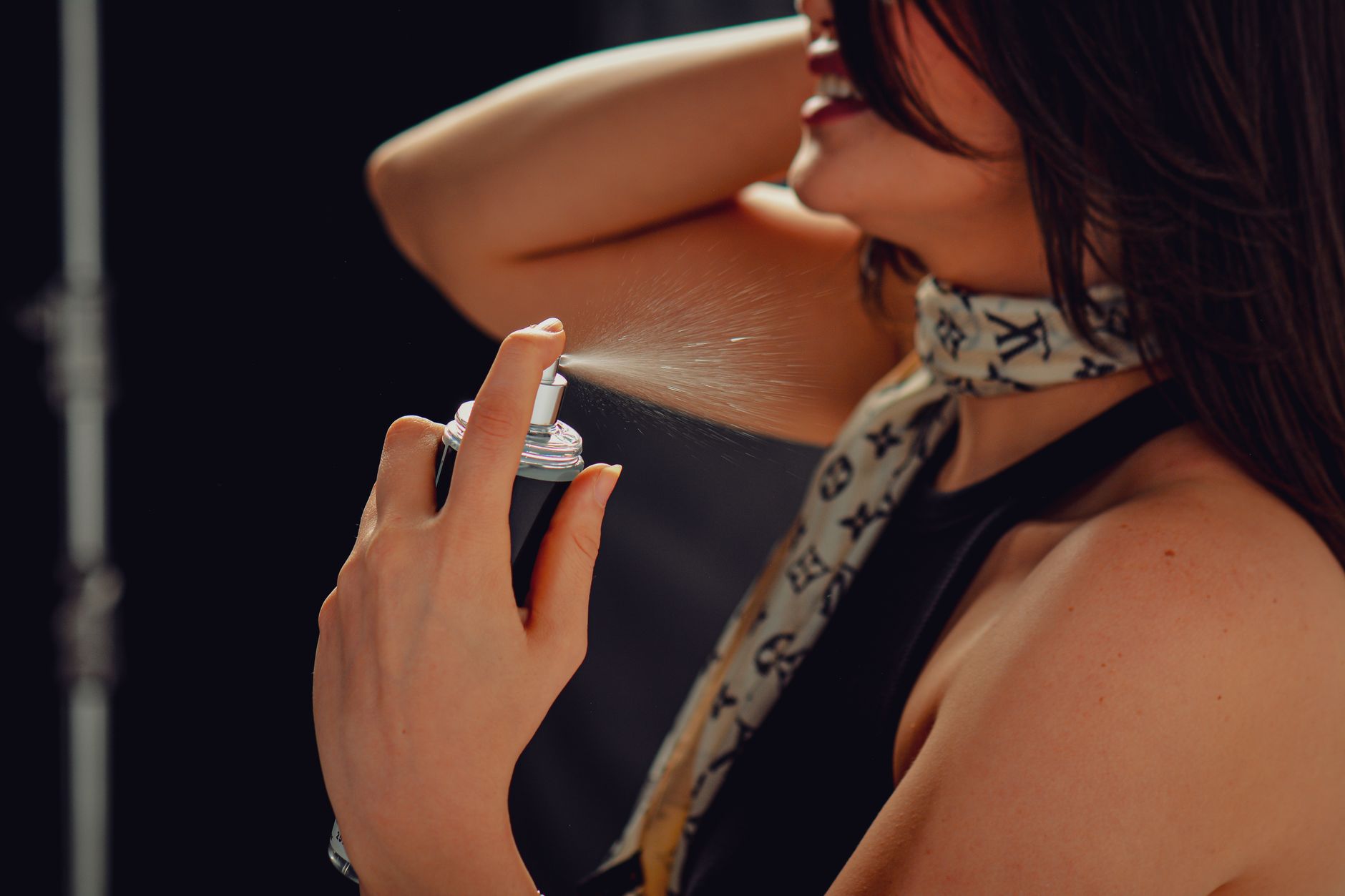
Finding your scent identity follows a similar logic to finding any other kind. You try something, it fits or it doesn’t, you learn something about yourself from the fit or the failure, and you try again. The difference, when you’re doing this as a trans woman, is that each attempt carries a secondary charge – the fragrance isn’t just telling you who you are, it’s telling the world. Every spritz is a small declaration. Some fragrances stick around for years for exactly that reason – once you find one that says the right thing, you hold onto it.
What strikes me most, looking back, is how much of my transition happened in the invisible register – in scent, in tone, in the things only I knew about in the beginning. A name is public the moment someone says it. A fragrance is public the moment you wear it, but it’s also private in a way names never quite are. Nobody hands you a bottle and tells you what it means. You figure that out yourself, one note at a time, until something finally smells like you – and even then, the question of what comes next stays open.