





A Thriller Built Around the Danger of Needing to Be Loved
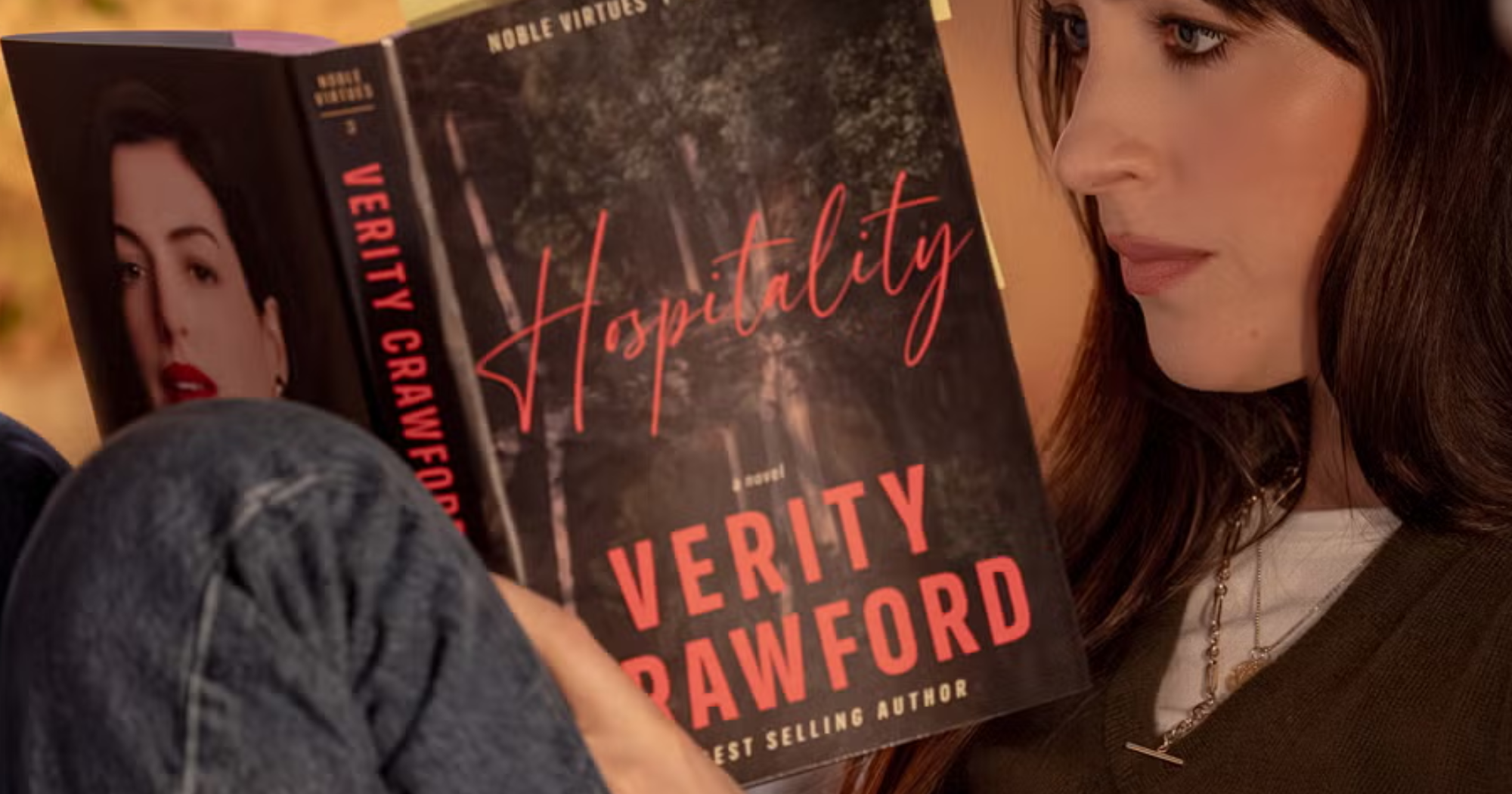
Colleen Hoover’s Verity has finally made it to theaters, and the book-to-screen adaptation arrives carrying the full weight of one of fiction’s most debated endings. The film stars Anne Hathaway as Verity Crawford, a successful novelist left paralyzed and unable to complete her book series, and Dakota Johnson as Lowen Ashleigh, the writer hired by Verity’s husband Jeremy Crawford – played by Josh Hartnett – to move into the family’s remote property and finish the final installment. What Lowen finds inside that house, hidden within a manuscript apparently written by Verity herself, sends the story spiraling into territory that’s equal parts psychological horror and marital tragedy.
It’s a film that doesn’t let anyone off the hook easily.
Both Hathaway and Johnson have been candid in press about what drew them to the material – and the themes they found themselves turning over long after the cameras stopped rolling. Chief among those themes: the quiet destruction that comes from building your sense of worth around someone else’s approval.
What Verity Crawford Wants – and Why It Costs Her Everything
The manuscript at the center of the film is the engine of its tension. When Lowen reads it, she’s confronted with a portrait of Verity as someone consumed by her husband’s opinion of her. Johnson described the dynamic plainly: “The way she’s written herself is wanting Jeremy’s approval. She worships him.” That observation carries more weight than it might initially seem, because the manuscript doesn’t just reveal dark thoughts – it raises the question of whether Verity constructed the entire document as a kind of desperate performance, a way of becoming the woman she believed Jeremy wanted her to be.
The film’s central debate – Team Letter versus Team Manuscript – splits audiences on whether Verity is a victim or a manipulator. A letter discovered by Lowen near the end of the story reframes everything she’s read, suggesting the manuscript may have been a writing exercise rather than a genuine confession. Hathaway has publicly declared herself Team Letter, meaning she believes Verity is the victim in the story, not the architect of its horrors. That interpretation shifts the villain’s identity squarely onto Jeremy, which changes how every earlier scene reads in hindsight.
But even within Hathaway’s reading of the character, something troubling remains: the degree to which Verity, paralyzed and dependent, appears to have oriented her entire inner life around a man’s validation. Whether that’s a survival mechanism or a character flaw – or both – is exactly the kind of question the film refuses to answer cleanly. That refusal is part of what has made Hoover’s novel such a persistent cultural flashpoint since its publication, and what gives the film its unsettled, argumentative energy.

What Hathaway and Johnson Actually Think About Chasing Approval
The conversation both actors have been having in interviews goes beyond plot analysis. Hathaway was direct about the psychology underneath Verity’s behavior: “I think chasing most things is probably not great. Especially something like validation, because I think that you should optimally be around people where you don’t have to chase it. You have to know how to validate yourself.” There’s no hedging in that statement – she’s not framing self-worth as a destination or a practice. She’s framing the need to pursue approval from others as a structural problem in how someone has built their relationships.
Johnson’s take went somewhere slightly different, and more internal. “I think chasing validation is trying to fill a void that will never be filled by validation,” she said. “Outwardly looking for validation is never gonna give you what you’re looking for, is what I’ve learned.” The phrasing – “what I’ve learned” – keeps the observation personal rather than prescriptive, which makes it land differently than a standard press-circuit talking point. She’s not diagnosing Verity from a distance. She’s acknowledging a pattern she recognizes.
What both actors are circling around, without quite saying it outright, is that Verity is less interested in who the villain is than in what conditions make villainy possible. A woman who has surrendered her interior life to the project of being desired by one person has, in some sense, already lost the plot before the first chapter ends. The manuscript – real or fabricated – is the document of that loss. Whether Verity wrote it as confession or fiction, she still wrote it, and it still says something devastating about how she understood herself.
The Team Letter Argument and What It Changes
Hathaway’s alignment with Team Letter isn’t a casual preference – it’s a reading that restructures the film’s moral architecture entirely. If the manuscript is a fiction, then Lowen has been manipulated by a document designed to make her sympathize with Jeremy and distrust Verity. The woman everyone assumed was dangerous was actually the one in danger. And Jeremy, charming and grief-stricken on the surface, becomes something far colder: a man who either allowed that misreading to happen or actively engineered it.
Fans have been split on this question since the book’s release, and the film adaptation isn’t likely to settle anything – which is, presumably, the point. Both interpretations are internally consistent. Both leave the other characters implicated in something. And both hinge on a single piece of paper found at the end of a story that has already taught its audience not to trust what it reads.
Dakota Johnson’s Lowen is the audience’s surrogate throughout – a woman who enters a house full of silence and leaves with more questions than she arrived with, having made an irreversible decision based on information she can’t fully verify. That’s the film’s actual trap, and it’s sprung in the final minutes. Verity opens in theaters this week, and the arguments about that letter are already starting again.