




The Long Game Starts Now
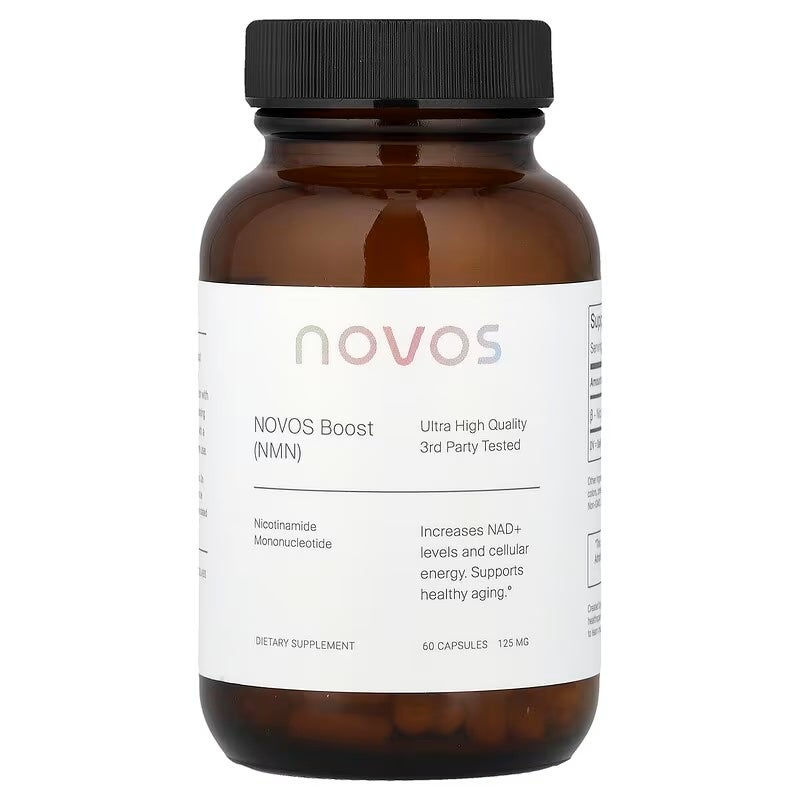
Supplements have never earned much trust from me. The category is full of overpriced powders and gummies that do little beyond look good on a bathroom shelf – and gummy vitamins deserve their own separate reckoning. So when nicotinamide mononucleotide, better known as NMN, started showing up everywhere from The Skinny Confidential orbit to Bryan Johnson’s very public self-optimization project, I did what felt rational: I scrolled past it. That changed when I actually sat through David Sinclair’s appearance on Diary of a CEO. The science wasn’t easy to dismiss.
I want to be clear about my starting point. I’m in my thirties, I feel well, and I’m not chasing a dramatic transformation. My interest in NMN was never about next month – it was about who I want to be at ninety. That framing matters, because it shaped what I was willing to commit to. I bought a bottle of Novos Boost at Erewhon (we’ll get to the price), locked in for 30 days, and told myself I wouldn’t form a single opinion before the month was up. What happened surprised me, and the timeline was faster than I expected.

What NMN Actually Does Inside Your Body
Novos Boost is built on a single scientific premise: aging is not a fixed destiny, it’s a biological process – and biological processes can be influenced. The mechanism centers on NAD+, a coenzyme responsible for cellular energy production. NAD+ levels drop naturally as we age, and that decline has downstream consequences: slower cellular repair, reduced metabolic function, skin that starts losing its edge, and a low-grade fatigue that gradually starts feeling like just how life is. NMN works by replenishing NAD+ at the cellular level, giving the body more raw material to work with.
What I didn’t anticipate was how much the sourcing conversation would matter to me. I had heard the phrase “third-party tested” for years and let it wash over me without really understanding what it meant in practice. Dr. Rhonda Patrick’s breakdown on Diary of a CEO changed that. Supplement brands in the U.S. can legally print almost anything on a label – including ingredients that are barely present, or absent entirely. Dr. Patrick used creatine gummies as her example: most of them contain little to no actual creatine. That detail lodged itself in my brain and made me significantly less casual about handing over money to any supplement brand that hadn’t verified its contents through independent testing.
The Erewhon Tax and Why I Paid It
Novos Boost retails at $44. I bought mine at Erewhon, which, as anyone who has walked through that sliding door knows, adds a particular kind of premium to the experience – not just in price, but in the implicit social contract that the product has already been vetted by a store that treats ingredient sourcing like a religion. That’s not nothing when you’re buying something you’re going to put in your body every day for a month.
The routine itself was simple enough not to become a friction point. One dose daily, same time each morning, no dramatic protocol around it. I wasn’t stacking it with anything else new during the 30-day window, which mattered to me for clarity – if something changed, I wanted to be able to attribute it with some confidence rather than crediting a cocktail of variables.
The first two weeks were quiet. No surge of energy, no sudden clarity, nothing that would make for a compelling before-and-after post. I was okay with that. I’d gone in expecting the long game, and the long game doesn’t usually deliver its receipts in week one. But around day 18, something shifted in my sleep. I was falling asleep faster and waking up without the usual drag. Not dramatically – but consistently, which felt more credible than a one-night spike.
Then came the neck comment. A stranger – someone I’d never met, in a context with no social incentive to compliment me – looked at me and said something about my neck looking good. That is such a specific, unscripted observation that I almost didn’t know how to receive it. Necks are not a common compliment category. Nobody says that. And yet there it was, unprompted, on day 26.
The Skeptic’s Honest Read
I’m not prepared to declare that NMN reversed anything. Thirty days is a short window, the sample size is one person, and I have no baseline bloodwork to compare against. What I can say is that the changes I noticed – the sleep quality, the skin observation from a stranger, a general sense of something running more smoothly – arrived without any lifestyle overhaul on my end. No new diet, no new workout, no new skincare product introduced during the same window.
What stays with me is the NAD+ argument itself. If cellular energy production genuinely declines with age, and if NMN genuinely helps replenish the coenzyme that drives it, then starting before the deficit becomes visible is the only version of this that makes logical sense. You don’t wait until your skin is flagging and your fatigue is chronic to address the underlying mechanism. You start while things still look fine, which is a counterintuitive ask in a culture wired toward fixing problems rather than anticipating them.

What I’m Carrying Forward
I ordered a second bottle. That feels like the most honest data point I can offer – not a transformation story, not a before-and-after, just a straightforward decision to continue. At $44, it’s not a casual line item, and I’m someone who scrutinizes supplement spending with the same energy I’d apply to anything else I do every single day for the foreseeable future.
The third-party testing piece is the part I keep coming back to as a baseline for anything I’d recommend. Dr. Patrick’s creatine gummy example stuck with me because it’s not a fringe case – it’s a reflection of how loosely regulated the supplement industry remains. Novos Boost being independently verified doesn’t make it magic. But it does make it something you can trust is actually inside the capsule, which turns out to be the bare minimum worth caring about before everything else.
The neck comment, though. Twenty-six days in, from a stranger with no stake in the outcome, about a body part that isn’t even on most people’s skincare radar. If NAD+ decline affects cellular repair across the board – skin included – then maybe that’s exactly where you’d expect to see the first sign of something working. Or maybe it was a coincidence. I’m watching for month two to decide which.