



The Mountains Don’t Care About Your Inbox
There’s a specific kind of exhaustion that doesn’t show up in your body – it lives in the background of every conversation, every meal, every supposedly relaxing Sunday. I landed in Canada carrying exactly that. My bags were uncharacteristically organized: right amount of underwear, coordinated outfits, toothpaste accounted for. For a self-identified chaotic Type B traveler, this counted as personal evolution. What I hadn’t managed to leave behind, tucked somewhere between my layers and my moisturizer, was the low hum of obligation that follows me everywhere.
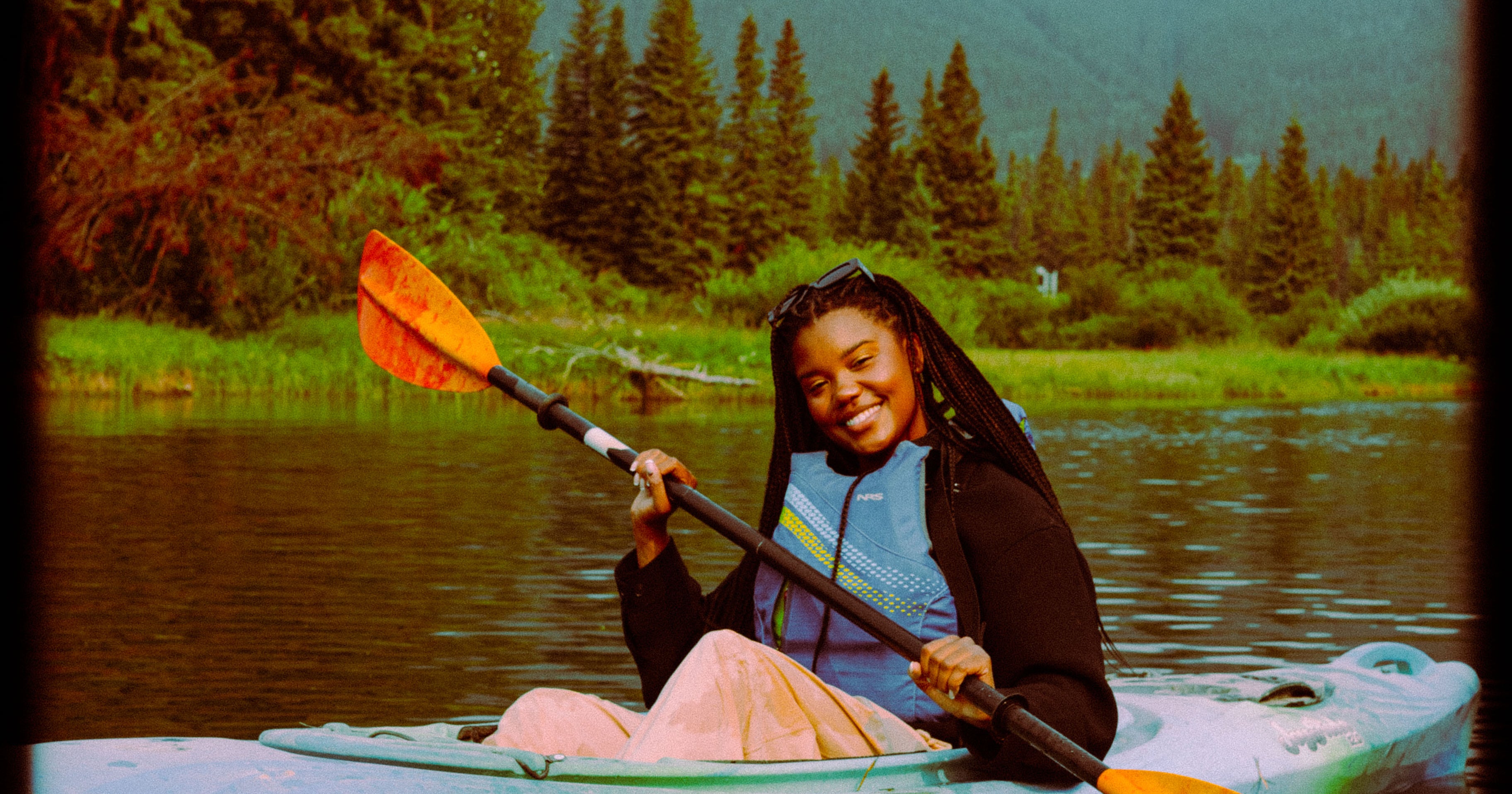
The trip was three days in the Canadian Rockies, arranged by Moxy Banff and Marriott Bonvoy Moments. The itinerary covered Lake Louise, Moraine Lake, and the Bow River – places that exist on screensavers for a reason. Somewhere during the hour-long drive from the airport to Moxy Banff, cell service started dropping out in patches. The mountains appeared in layers, ridge behind ridge, and I made a decision that sounds small but wasn’t: whatever was waiting back home could keep waiting.
Two Intentions, One Camera, and a Commitment to Doing Scary Things
On the flight over, in the particular dreamlike haze that a Pisces will recognize immediately, I set two intentions for the trip. The first was to become more present – not in the abstract way people mean when they say it at dinner parties, but actually present, in the bees-landing-on-flowers, noticing-the-texture-of-things sense. The kind of present that makes you feel, years later, like you actually lived the moment rather than managed it.
To force myself into that mode, I packed my camera. Photography had been, for a long time, the way I processed the world – a practice I’d slowly crowded out with productivity. On this trip it became the structure around which everything else would hang. Raising a camera at something means committing to looking at it. It’s harder to half-experience a lake when you’re framing it.
The second intention was blunter: do scary things. Not cliff-diving-into-oblivion scary, but the specific discomfort of saying yes when the easier answer is “maybe later.” The Canadian Rockies offer a fairly unambiguous backdrop for this kind of reckoning. There’s nothing subtle about a mountain. It doesn’t invite you to hedge.
What I was building, without fully naming it yet, was a personal policy for the next 72 hours – say yes to everything. It sounds like a rom-com premise, and maybe it is. But there’s a difference between being spontaneous and being intentional about spontaneity. One is reactive. The other requires deciding, in advance, that your comfort zone is temporarily suspended.

The Specific Geography of Letting Go
The Canadian Rockies don’t ease you in. Banff sits inside a national park, ringed by peaks that make your sense of personal scale recalibrate almost immediately. Lake Louise runs turquoise in a way that looks edited even in person. Moraine Lake sits in a valley of ten peaks and has the quietly destabilizing effect of making every problem you brought with you feel administratively irrelevant. The Bow River cuts through the landscape with enough force that you stop thinking about your notifications and start thinking about water.
This is what landscape does when you let it. The problem is most people don’t let it – they visit it. There’s a meaningful gap between those two things, and it runs directly through the question of attention. My camera helped close that gap. Framing a shot of the Rockies means deciding what matters inside the frame, which turns out to be excellent practice for deciding what matters outside it.
Productivity Is Not the Same Thing as a Life
My actual life, the one I’d temporarily abandoned, revolves around deadlines, work, and a notification stream that never fully quiets. I had become genuinely skilled at being productive and correspondingly worse at being present. Even on previous vacations, there was always a corner of my brain filing away what needed to happen when I got back. Banff was a deliberate experiment in cutting that off.
What surprised me wasn’t the mountains – I’d seen pictures. What surprised me was how much resistance my own brain put up in the first hours. The reflex to check, to optimize, to stay slightly ahead of whatever’s coming next is not a habit that pauses just because you’re standing next to a turquoise lake. It has to be actively interrupted, repeatedly.
Photography helped with that interruption. So did the physical reality of spotty cell service along the drive, which removed the option to half-engage with real life while standing in an objectively extraordinary one. When the signal dropped, the decision made itself. By the time I reached Moxy Banff, the compulsion had softened enough that I noticed it without immediately acting on it. That’s not enlightenment. That’s just the beginning of something.
The trip was three days. The Rockies are still there. And the question I brought home – somewhere between the camera roll and the collected receipts – is whether a place can teach you a habit, or whether it just shows you what the habit would feel like, and leaves the rest to you.