




The Neck Finally Gets Its Own Device
For years, the skincare industry treated the neck like an afterthought – a surface you swipe leftover moisturizer across before bed and quietly hope for the best. The face got the serums, the tools, the technology. The neck got ignored. That dynamic is shifting now, and LED neck masks are sitting at the center of it: wearable light therapy devices shaped specifically for the contours of the neck and decolletage, designed to address firmness, skin tone, and texture in a zone that wrinkles faster than most people expect.
Glamour’s tested-and-reviewed roundup of the five best LED neck masks for 2026 makes clear this category has matured well past novelty status.
These are not spa add-ons. They are at-home devices built around the same light wavelength science used in clinical settings – red light for collagen stimulation, near-infrared for deeper tissue repair, and in some models, blue light to address surface-level concerns. The neck, which has thinner skin and fewer sebaceous glands than the face, responds to this kind of targeted treatment differently and, in many cases, more visibly.
Why the Neck Ages Faster and Why Light Therapy Addresses It
The mechanics behind why necks show age so readily come down to anatomy and habit. The skin on the neck is thinner than facial skin, which means collagen loss – a natural process that accelerates after the mid-thirties – shows up faster. Add decades of looking down at phones and laptops, and the horizontal lines that form there become deeply set long before people think to treat them. Sun exposure compounds this: the neck is often left unprotected when sunscreen is applied, creating cumulative UV damage that erodes elastin and deepens discoloration over time.
LED therapy works by delivering specific wavelengths of light into the skin’s layers without heat or damage. Red light, typically in the 630 to 700 nanometer range, has been studied for its ability to stimulate fibroblast activity – the cells responsible for producing collagen and elastin. Near-infrared light, which sits above 700 nanometers, penetrates deeper into tissue, supporting cellular repair and reducing inflammation. The result, with consistent use, is skin that looks firmer and more even, with fine lines appearing less pronounced over time. These are not instantaneous changes. Most devices require regular sessions over weeks before visible results accumulate.
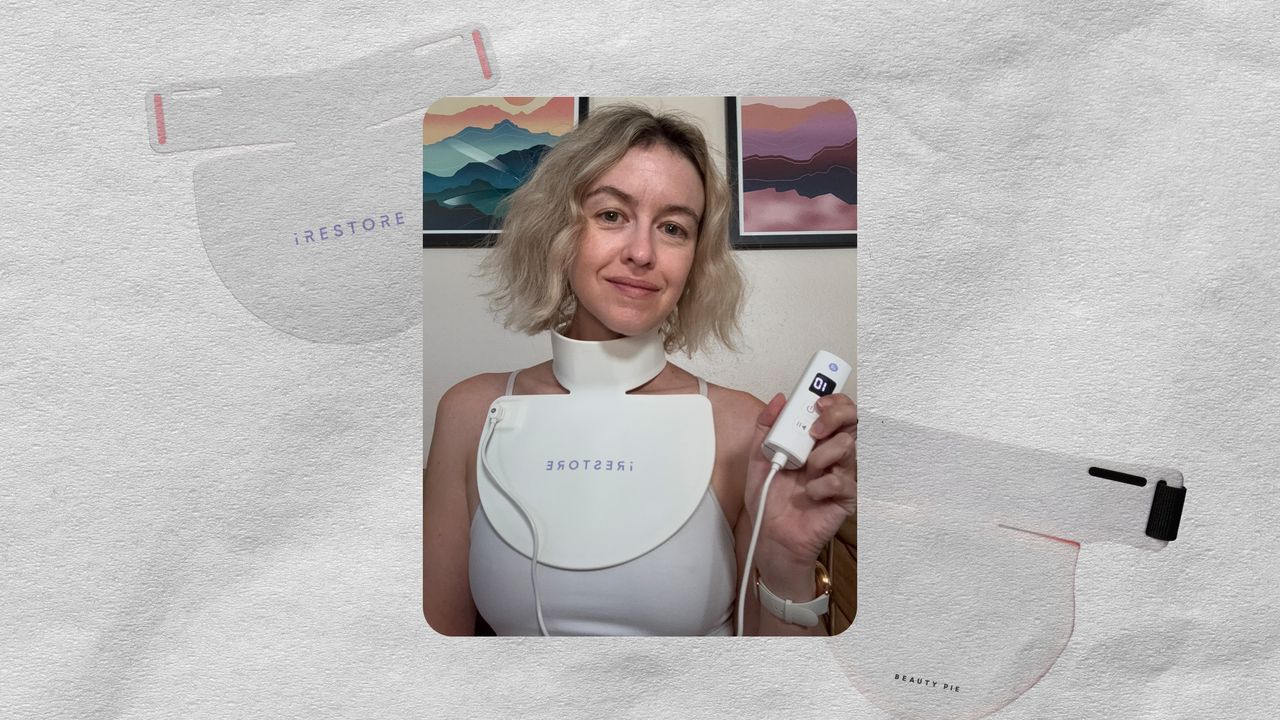
The shape of an LED neck mask matters more than it might seem. A flat panel held loosely against curved skin delivers inconsistent light exposure. The better-performing devices in Glamour’s 2026 roundup are contoured to wrap the jaw, throat, and upper chest simultaneously, ensuring the light-emitting diodes maintain close, even contact with the skin across the entire treatment area. That contact distance – how close the LEDs sit to the skin surface – directly affects how much energy actually reaches the tissue where it can do anything useful.

What Separates a Good LED Neck Mask From a Mediocre One
Not all LED devices are created equally, and the neck mask category has its share of products that look clinical but perform poorly. The key variables are LED count, wavelength accuracy, irradiance output, and fit. A mask with dozens of LEDs means nothing if those LEDs are emitting light outside the therapeutic wavelength ranges or at an intensity too low to penetrate beyond the skin’s surface. Irradiance – measured in milliwatts per square centimeter – determines whether the device is actually delivering enough energy per session to stimulate any biological response. Many consumer devices stay deliberately vague about this number.
Fit is where a lot of neck masks fail in practice. The neck is not a flat surface. It curves, it moves, and it connects to a jaw on one end and a collarbone on the other. A mask that gaps at the sides or slides down during a session is wasting your time and your money. The devices that perform best in hands-on testing tend to be those with flexible panels, adjustable straps, or a bib-like design that covers the decolletage as well – because the chest is often where sun damage is most visible and where the skin is similarly thin and underserved by most skincare routines.
Session length also factors into real-world usability. Most effective LED neck masks require somewhere between 10 and 20 minutes per session, with manufacturers recommending daily or near-daily use for the first several weeks, tapering to maintenance sessions afterward. That time commitment sounds small but adds up – and it explains why comfort, wearability, and whether the device is hands-free or not end up mattering as much as the technology itself. A mask you stop wearing after two weeks is not treating anything.
The 2026 Landscape: Tested Devices and What They Do
Glamour’s 2026 testing process for the best LED neck masks evaluated devices on brightness, skin contact, comfort, and visible results over time – the kind of assessment that separates editorial testing from brand-supplied claims. The roundup identifies five top performers, with options spanning different price points, wavelength combinations, and design approaches. Some prioritize red and near-infrared light exclusively for a focused anti-aging effect. Others layer in blue light for a dual approach that also addresses uneven texture and surface concerns.
The price range across top-performing LED neck masks varies considerably. Entry-level options can sit below $100, while premium devices with higher LED counts, multiple wavelength modes, and stronger clinical research backing can push past $300 or $400. That gap reflects real differences in components and output – cheaper devices often use fewer LEDs at lower irradiance – but it does not mean the most expensive option is always the right one for a given person’s skin concerns or routine. The best device is the one with the right wavelengths for your specific goals and a design you will actually keep using.
Skincare founders like Amy Liu, who built Tower28 around the idea that less-addressed skin needs deserve real solutions, represent a broader shift in how the industry is finally thinking about what gets left out of the standard routine. The neck has been one of those gaps for a long time. LED technology has been available for years – it just took this long for the device form factor to catch up to the anatomy it was supposed to serve.
What remains unresolved is consistency. The LED neck mask market in 2026 still has no standardized testing requirements for consumer devices, which means irradiance claims and wavelength specifications vary in how rigorously they are verified. A device marketed as red light therapy might be delivering light at the right wavelength or it might be close enough to look red without hitting the therapeutic range. Until regulatory clarity arrives – and there is no timeline for that – the most reliable signal is third-party testing and editorial reviews that clock real results over real time. Five masks made that list. Most didn’t.