





He-Man Is Back, and Apparently So Are Loincloth Jokes
Masters of the Universe arrives as one of 2026’s bigger blockbuster releases, adapted from the ’80s toy line that built an entire mythology around a man in a loincloth shouting about power. Whether any of that mythology translates to a modern audience mostly depends on your tolerance for camp – and, apparently, how much you enjoy jokes about Nicholas Galitzine’s thighs.
What This Movie Actually Is
The franchise has been here before. There was the original animated series, and then the 1987 live-action film with Dolph Lundgren as He-Man and Courteney Cox playing a teenager caught up in an inter-dimensional power struggle. That version became a cult object mostly through irony. This new film is something different – self-aware from the start, less interested in mythology-building than in having a good time inside it.
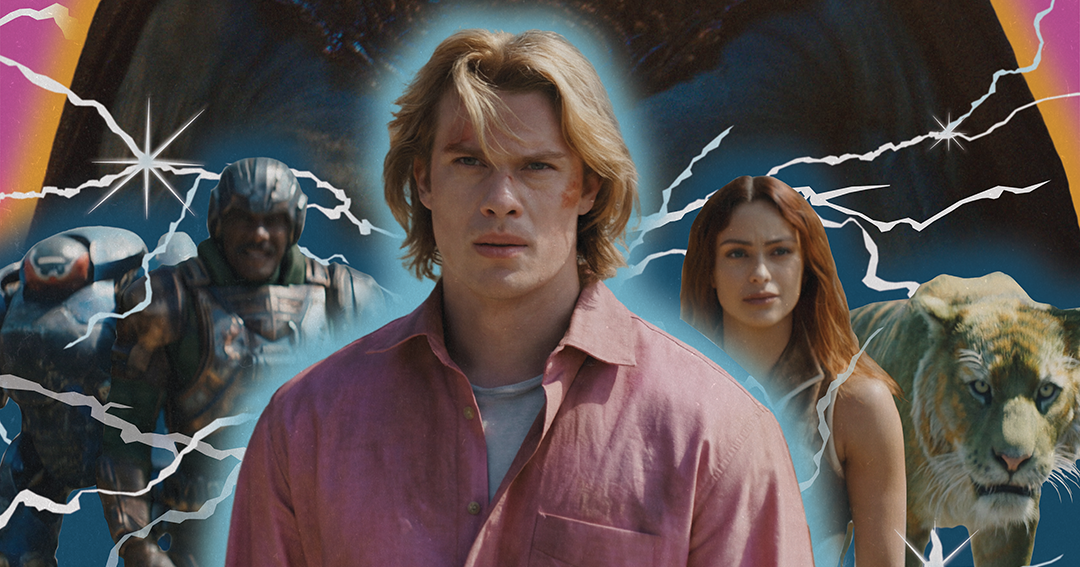
The cast alone signals an intention to entertain rather than world-build solemnly. Nicholas Galitzine plays Adam, the unlikely prince who transforms into He-Man. Camila Mendes plays Teela. Jared Leto takes on Skeletor – the skull-faced villain who, in this version, gets at least one line so aggressively absurd it was apparently written down in a reviewer’s notes on the spot. Alison Brie is Evil-Lyn, and Idris Elba plays Duncan, a character who has historically served as He-Man’s weapon-making mentor.
The film’s central theme sits somewhere between earnest and generic: heroism isn’t inherited, confidence is the actual power, and ordinary people can rise to the moment. That’s a well-worn framework. What saves it from feeling stale is that the movie doesn’t seem to be taking that message especially seriously – it delivers it between action sequences and physical comedy, more interested in momentum than meaning.
Entertainment writers Bernice Corral and Rachel Choy, both of whom reviewed the film, came in with different expectations. Corral hadn’t grown up with the IP and only really knew it through internet memes. The trailer reminded her of Guardians of the Galaxy and Thor: Ragnarok – two films she counts among her favorite Marvel entries – which set a favorable expectation. Choy hadn’t watched the cartoon either, describes herself as largely indifferent to superhero films, and went in drawn mostly by how goofy it looked.

Where It Actually Lands
Both writers came out entertained, which is not a small thing for a property that could easily have collapsed under nostalgia pressure or overcorrected into grim seriousness. The film fits cleanly into the summer release window – it’s built for that environment, designed around energy and spectacle rather than weight. That’s not a criticism. A movie that knows exactly what it is and executes it well is doing something most big-budget adaptations struggle with.
The comedy is consistent and leans hard on the inherent absurdity of the source material. Characters repeatedly comment on Adam’s physical appearance – his muscles, his tan, his loincloth – with a frequency that apparently never lost its impact across the full runtime. Choy specifically flagged a Skeletor line: “Your long sword dangling between your glorious thighs.” Delivered by Jared Leto as a skeleton-faced megalomaniac, it lands somewhere between ridiculous and genuinely funny, which is probably exactly where the writers intended it.
Corral’s response to the line – “He was right!” – captures the film’s particular register. It’s not winking irony that holds the material at arm’s length. It’s more like the cast and filmmakers decided to be fully committed to something silly, which produces a different effect. There’s a version of this movie that tries to reimagine He-Man as grounded and operatic, presumably in the style of early Zack Snyder. This is the opposite of that version.
The question of who the film is actually for
is harder to answer. Corral and Choy both came in without strong nostalgia for the IP and left satisfied. That might be the real indicator – this isn’t a film that rewards prior investment, and it doesn’t seem particularly designed to protect the feelings of people who grew up watching the cartoon. It uses the property as scaffolding for something that plays to a broad contemporary audience, especially one that enjoyed the tonal mix of the recent Marvel films that leaned comedic.
Whether Galitzine’s version of Adam works as a character beyond the physical jokes is something the reviewers landed on differently. The film argues that power comes to the unlikeliest people – Adam starts from a place of insecurity before the transformation clicks. That arc is functional without being particularly original. What distinguishes it is Galitzine’s performance, which apparently carries enough charm to make the familiar beats land. The thigh commentary helps, but it’s not doing all the work.
The Lingering Questions
One thing Corral raised but left open: whether the jokes about Adam’s body, the loincloth, and the general fixation on his appearance are carried over from the original cartoon, or whether this is a new layer the filmmakers added. The ’80s animated series was, in retrospect, aggressively homoerotic in ways that were probably unintentional at the time and are now impossible to ignore. This film seems aware of that subtext and is at minimum comfortable living inside it.

Leto’s Skeletor is the performance most likely to define how people remember this film. A villain who delivers lines about thighs and long swords while maintaining menace – or failing to, which might be funnier – is a specific tonal challenge. Whether Leto fully solves it, or whether the film simply benefits from the audacity of the attempt, is the kind of thing worth seeing for yourself.